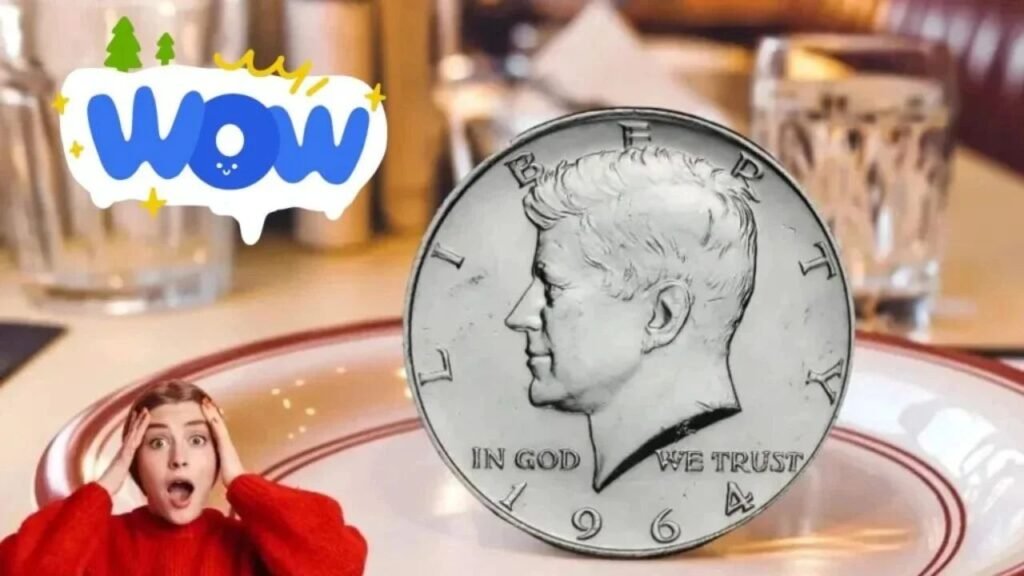
Imagine waiting tables, doing your regular job, and walking away with something that could change your life. That’s exactly what happened to Elena Martinez, a server at a small diner in Ohio. She was finishing up her morning shift, clearing dishes from a booth where an elderly man had eaten breakfast. Underneath his coffee-stained check sat a coin—bigger than a quarter, with a familiar face on it. Elena recognized it as a Kennedy half dollar, the kind her grandfather collected. She smiled, thinking it was a nice, old-fashioned tip worth maybe a dollar or two. Little did she know, that simple act of kindness was about to make headlines across the country. Kennedy Coin Left as Tip at Diner Now Making Headlines Nationwide
Grandpa’s Shocking Discovery
That evening, Elena visited her grandfather like she often did. She pulled out the coin to show him, mentioning how someone had left it as a tip. Her grandfather’s eyes lit up immediately. He reached for his magnifying glass—the one he’d used for decades examining coins—and took a close look. His hands started shaking slightly. “Elena,” he said slowly, “this isn’t just any half dollar. This is a 1964. And look at the condition—it’s nearly perfect.” He explained that 1964 was the first year they made Kennedy halves, right after the president was assassinated. People grabbed them up immediately and held onto them. Finding one this nice in circulation was like finding a needle in a haystack.
Kennedy Half Dollar Fast Facts
| Feature | Complete Details |
|---|---|
| First Year Made | 1964 |
| Why It Was Created | To honor President John F. Kennedy after his 1963 assassination |
| Designers | Gilroy Roberts (front), Frank Gasparro (back) |
| What It’s Made Of | 90% silver, 10% copper |
| How Much It Weighs | 12.5 grams (heavier than today’s half dollars) |
| Mint Locations | Philadelphia (no mark), Denver (D mark) |
| What Makes It Valuable | Condition, mint mark, proof strikes, errors |
| Regular Circulated Value | $10 to $20 (just from silver content) |
| Uncirculated Value | $20 to $100+ |
| Super Rare Examples | $500 to $100,000+ if certified |
| Why They’re Hard to Find | People hoarded them immediately in 1964 |
Why the 1964 Kennedy Half Dollar Is Special
Here’s the thing about the 1964 Kennedy half dollar—it’s not just money, it’s history in your hand. When JFK was killed in November 1963, the whole country went into mourning. The government rushed to put his face on a coin as a tribute, and by January 1964, they were making these halves like crazy. But here’s what makes 1964 different from every other year: it was the LAST time they made half dollars for circulation with 90% real silver. After 1964, they switched to less valuable metals. So every 1964 Kennedy half has serious silver value built right in. Plus, Americans back then weren’t spending them—they were saving them as souvenirs of a president they loved. That’s why finding one today, especially in good shape, is such a big deal.
Could This Coin Be Worth Life-Changing Money?
Now here’s where it gets really interesting. Elena’s coin isn’t just any 1964 half dollar. Her grandfather noticed something special: the details were incredibly sharp, like it had never been used. No scratches, no wear, no nothing. Professional graders are now looking at it, and early signs suggest it might be something special. If it turns out to be a proof strike—meaning it was specially made for collectors with a mirror-like finish—it could be worth thousands. If it has a rare mint error nobody’s caught yet? We could be talking tens of thousands of dollars. Elena, who works hard serving tables, suddenly has a chance to pay for nursing school without loans. All because someone left a “big” tip.
The Mystery of the Generous Stranger
So who left this treasure behind? The diner checked their security cameras and found footage of an older gentleman eating alone, paying cash, and walking out like any other customer. He had no idea he’d just given away a potential fortune. Maybe he knew exactly what it was and wanted to do something kind. Maybe he found it in his own pocket change and didn’t think twice. Either way, his anonymous generosity has sparked conversations all over the country. People are now checking their change jars, asking grandparents about old coins, and realizing that kindness sometimes comes back around in the strangest ways.
What This Story Teaches Us About Everyday Treasure
This whole thing has made people look at pocket change differently. That coin in your pocket could be 60 years old. It could be made of silver. It could have a mistake that makes it valuable. But more than that, Elena’s story reminds us that ordinary objects carry extraordinary stories. The Kennedy half dollar connects us to a moment in American history when the whole country stopped to grieve together. It’s a physical piece of the 1960s that somehow survived all these decades. And now it’s going to help a young woman become a nurse. Not bad for one breakfast shift, right?
Smart Tips for Checking Your Own Coins
Want to start looking for valuable coins like Elena’s? Here’s what experienced collectors suggest:
- Check every half dollar you get – Kennedy halves from 1964 are silver; 1965-1970 have some silver but less
- Look at the edge of the coin – Silver coins show solid silver on the edge; newer ones show a brown copper stripe
- Find the mint mark – On Kennedy halves, look on the back below the eagle, near the “R” in DOLLAR
- Never ever clean old coins – Cleaning destroys value faster than anything, so leave them exactly as found
- Handle coins by the edges – Fingerprints can damage surfaces over time
- Use a magnifying glass – Small details like mint marks and errors are hard to see with naked eyes
- Check dates carefully – Key dates like 1964, 1970-D, and 1987 are harder to find
- Ask older relatives – Grandparents might have old coins sitting in drawers for decades
Frequently Asked Questions
Q1: How can I tell if my 1964 half dollar is really silver?
Check the date first—only 1964 Kennedy halves are 90% silver. Then look at the edge of the coin. If you see a solid silver color all the way through, it’s silver. If you see a brown copper stripe in the middle, it’s a newer clad coin from after 1964.
Q2: What does “proof” mean and how can I spot one?
A proof coin is specially made for collectors with polished dies. It has super shiny, mirror-like backgrounds and frosted details that look almost white. Regular coins look more normal and dull. Proofs weren’t meant to be spent, so finding one in change is incredibly rare.
Q3: Where exactly is the mint mark on a Kennedy half dollar?
On the back of the coin (the reverse), look near the bottom. You’ll see the words HALF DOLLAR. Right above the space between the “E” and “R” in DOLLAR, there might be a tiny “D” for Denver. If there’s no letter, it’s from Philadelphia.
Q4: Could I actually find a valuable coin in my change today?
It’s rare but totally possible! People sometimes spend old coins accidentally, or families clean out houses and spend grandpa’s collection without knowing. Check every old-looking coin you get. It costs nothing and takes two seconds.
Q5: What should I do if I think I found something valuable?
First, don’t clean it! Put it in a safe place like a small envelope. Handle it by the edges only. Then do some research online using reputable coin sites. If it still looks promising, you can pay a professional grading service like PCGS or NGC to authenticate and grade it. This costs money, so only do it if you’re pretty sure it’s special.
Q6: What’s Elena planning to do with the money if the coin sells big?
She wants to become a registered nurse and help take care of sick people. She sees it as paying forward the kindness that stranger showed her. Pretty cool way to use unexpected money, right?
Q7: Are all old half dollars valuable?
Not automatically. Common dates from the 1970s and 1980s in worn condition might only be worth face value—50 cents. But any half dollar from 1964 or earlier has silver value, and certain dates and mint marks can be worth much more.
Q8: Why did people hoard 1964 Kennedy halves so much?
Two reasons: First, JFK was hugely popular and his death shocked the nation. People wanted something to remember him by. Second, the coin was 90% silver, so even back then, people knew the metal had value. They saved them by the millions, which is why nice ones are harder to find now.