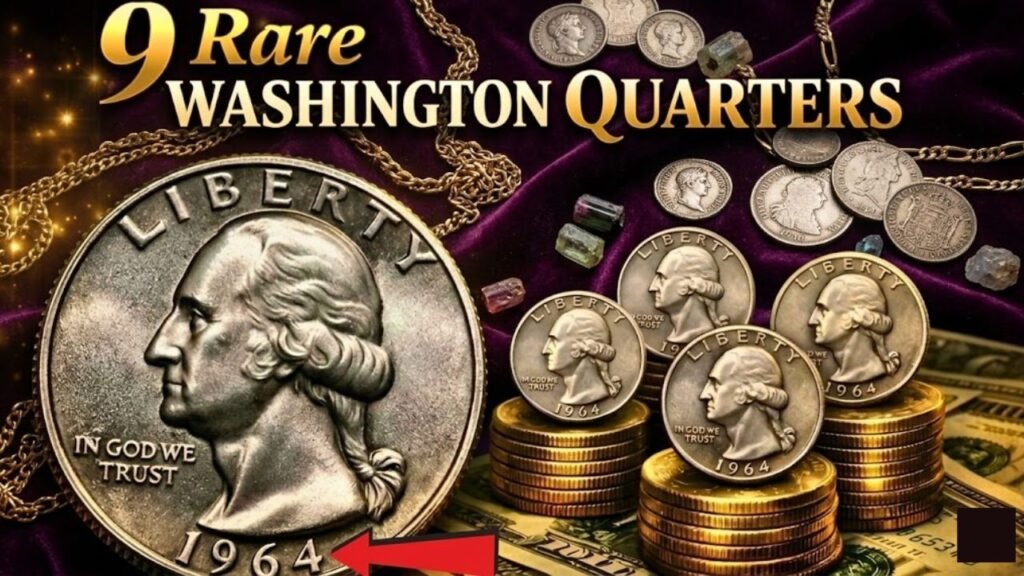
Imagine finding a quarter in your change that’s worth more than a used car—or even a year of college tuition. It sounds like a dream, but for coin collectors (also called numismatists), it’s the reason they check every piece of pocket change. The Washington Quarter has been around since 1932, and while most are only worth 25 cents, a few rare ones can be worth thousands. Let’s dive into the top 9 Washington Quarters that could be hiding in plain sight and are valued at a combined $50,700 or more in 2026. Top 9 Washington Quarters Valued at $50,700 Must Know Coin Guide for 2026
The Birth of a Coin Legend
The Washington Quarter was first made in 1932 to celebrate the 200th birthday of America’s first president, George Washington. A sculptor named John Flanagan designed it, showing Washington’s profile on the front and a powerful eagle on the back. For decades, these quarters jingled in the pockets of millions of Americans. But over time, people started noticing that some quarters had unique mistakes or were made in very small numbers, turning ordinary pocket change into prized collectibles.
Why Collectors Hunt for These Quarters
You might wonder, why would anyone pay thousands for a quarter? It’s a mix of history, rarity, and the thrill of the hunt. Some quarters are rare because the U.S. Mint didn’t make many of them that year. Others have fascinating errors, like a doubled image or a wrong mint mark. For collectors, finding one of these gems is like discovering a hidden piece of American history. The best part? You never know when you might find one in your grandma’s old coin jar or even in your own change.
The Big 9: Quarters That Could Make You Rich
Here’s a breakdown of the nine most valuable Washington Quarters that collectors are buzzing about in 2026. Check your collection for these dates and mint marks!
| Coin (Year & Mint) | Why It’s Special | Estimated High Value (2026) |
|---|---|---|
| 1932-D | First year of issue, very low mintage from Denver Mint. | $15,000+ |
| 1932-S | Also a first-year key date, very scarce from San Francisco Mint. | $12,000+ |
| 1937 Doubled Die Obverse | Noticeable doubling on the date and lettering “IN GOD WE TRUST”. | $7,000+ |
| 1942-D Over Horizontal D | A mint mark error where a “D” was stamped over a sideways “D”. | $5,000+ |
| 1950-D/S Overmintmark | A Denver quarter struck over a San Francisco coin; the “S” is visible under the “D”. | $4,500+ |
| 1955 Doubled Die Obverse | A dramatic and easily seen doubling on the front, making it a famous error coin. | $3,500+ |
| 1964-D | The last year quarters were made with 90% silver, marking the end of an era. | $1,500+ |
| 1970-S Proof Quarter | Some proof coins were accidentally struck on silver planchets meant for other coins. | $2,000+ |
| 1983-P | Surprisingly scarce in top condition because most were heavily used in circulation. | $200+ |
Note: These values are for coins in excellent, uncirculated condition. A beat-up version will be worth much less, but still could be a great find!
Quick Tips for Young Collectors
Starting a coin collection is easier than you think. Here are some simple tips to help you begin your own treasure hunt:
- Look closely at the dates and mint marks: The mint mark is a tiny letter (D for Denver, S for San Francisco, or P for Philadelphia) usually found on the front, just behind Washington’s ribbon. This is your first clue to a coin’s rarity.
- Check for errors: Hold the quarter up to the light and look for doubled letters or numbers, strange marks, or anything that looks out of place.
- Never clean your coins! This is the #1 rule. Cleaning a coin scratches the surface and ruins its value for collectors.
- Handle coins carefully: Always hold a coin by its edges to keep the front and back surfaces from getting fingerprints or smudges.
- Store them safely: Keep your coins in special holders, flips, or albums to protect them from dirt and damage.
- Research and have fun! Use online price guides and books to learn more. The best part of collecting is the history and the stories you uncover.
Frequently Asked Questions (FAQs)
1. How do I find the mint mark on a Washington Quarter?
Look on the front (obverse) of the coin, to the right of George Washington’s ponytail. The year is on the left side. The mint mark is a small “D,” “S,” or “P” (though Philadelphia coins from 1965-1967 didn’t have a mark).
2. What’s the difference between a “key date” and an “error coin”?
A “key date” is a coin that is rare because the U.S. Mint made very few of them that year, like the 1932-D. An “error coin” is rare because of a mistake made during the minting process, like the 1955 doubled die.
3. My quarter is old and dirty. Should I clean it?
Absolutely not! Cleaning a coin with polish, soap, or chemicals will scratch the surface and destroy its value. Collectors want coins in their original, natural state. The dirt is part of its history!
4. Where can I find out how much my quarter is worth?
You can start by looking at online price guides and recent sales on websites like eBay (search for “sold listings”). For the most accurate value, you can take it to a local coin dealer or get it professionally graded by a service like PCGS or NGC.
5. Are quarters from the 1970s and 1980s worth anything?
Most are not, but as you can see from the 1983-P on our list, some modern quarters can be valuable if they are in perfect, uncirculated condition. So, it’s always worth checking!
6. I have a 1965 quarter. Is it silver?
No. 1964 was the last year for U.S. quarters made mostly of silver. Quarters made in 1965 and later are made from copper and nickel, which is why they look a bit different. The 1964-D is valuable because it’s the last of the silver quarter era.
The Enduring Legacy of a Simple Quarter
The most important lesson from these top nine valuable quarters is that treasure can be found anywhere. It encourages us to look closer at the world around us and appreciate the history in everyday objects. Whether you find a rare 1932-S or just enjoy building a complete collection, Washington Quarters offer a fun and exciting window into the past. So next time you get change, don’t just toss it in your pocket—take a second to look. You might just be holding a small piece of history worth a fortune.